What this module does
Age every outstanding invoice automatically, flag accounts whose debt is creeping toward risky territory, and score each company's payment behavior — so you know who's a reliable slow payer and who needs immediate attention.

Know exactly who owes what, for how long, and who's actually at risk — before you pick up the phone.
Chasing debt shouldn't start with a spreadsheet. FlexiAres gives your credit control team one dashboard that ages every outstanding invoice automatically, flags accounts whose debt is creeping toward risky territory, and scores each company's payment behavior — so you know who's a reliable slow payer and who needs immediate attention.
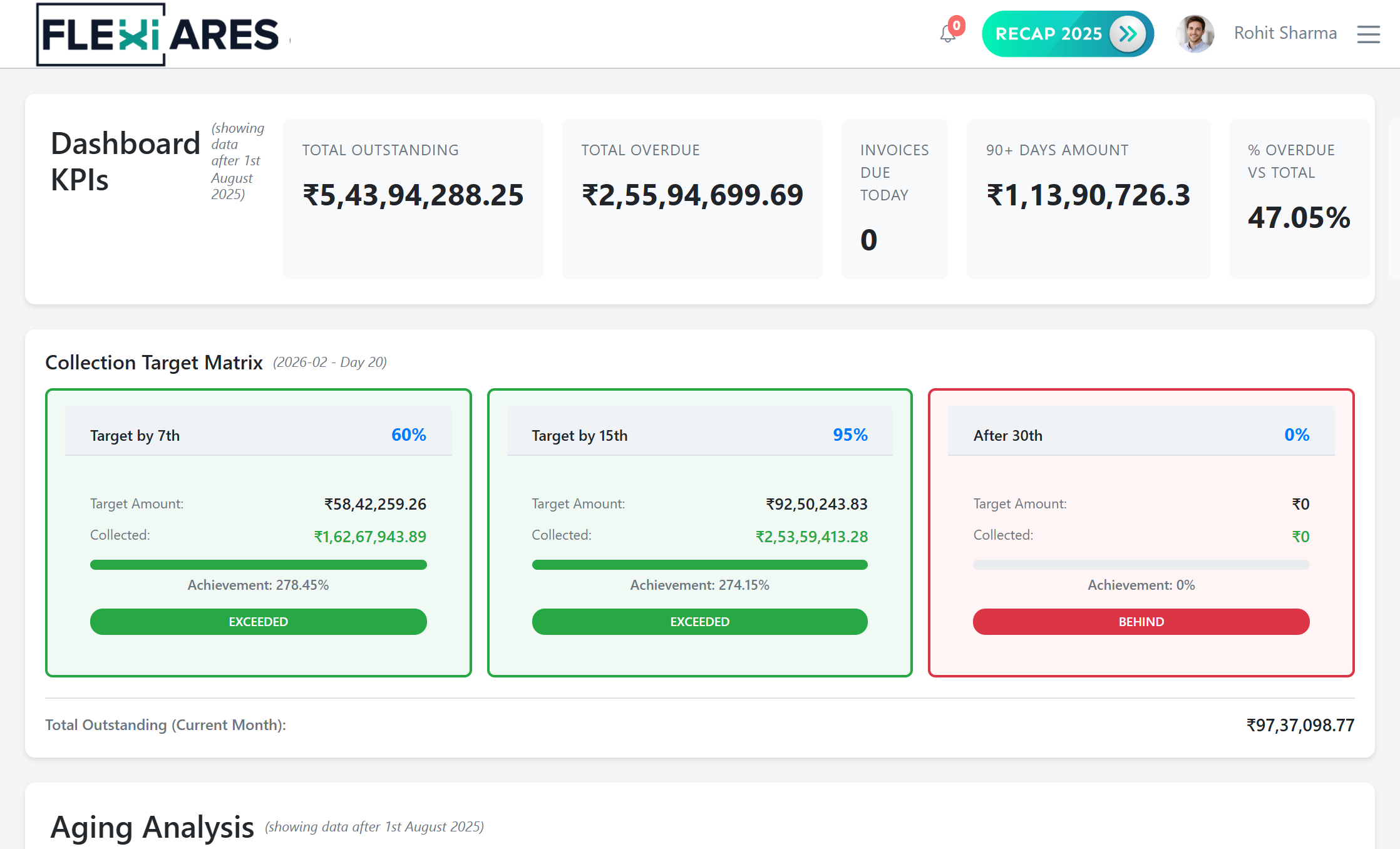
Age every outstanding invoice automatically, flag accounts whose debt is creeping toward risky territory, and score each company's payment behavior — so you know who's a reliable slow payer and who needs immediate attention.
Outstanding invoices grouped by how overdue they are, calculated for you.
See at a glance how much each client owes and how old that debt is.
Accounts crossing a risk threshold are surfaced without manual review.
See why an account is flagged, not just that it is.
A clear, per-company number showing typical time-to-pay.
See whether payment behavior is improving or worsening.
Flag a contested invoice directly from its dashboard row.
See unmatched payments per company alongside outstanding balances.
Combine aging, risk flags, and behavior trends to know who to chase first.
Every open invoice is automatically grouped into aging bands — from current to significantly overdue — with totals calculated per company. No manual date math, no exporting invoice lists to a spreadsheet to figure out what's actually overdue. Centre-wise and multi-location portfolio views are covered for operators scaling across sites — see Multi-Location Operators. For the full reporting suite and exportable audit tools, see the Operator Admin Dashboard.
A high average delay doesn't tell the whole story. FlexiAres analyzes each company's payment history and recent trend, so your team can tell the difference between a company that's always paid a little late and one whose behavior is actively getting worse.
Sometimes a customer has already paid — the payment just hasn't been allocated to an invoice yet. FlexiAres surfaces unallocated payment totals per company right on the dashboard, so your team checks for a hiding payment before making an awkward collections call.
Every outstanding invoice is automatically grouped into aging buckets based on how overdue it is, with totals calculated per company — no manual sorting or date calculation required.
FlexiAres automatically flags a company when its outstanding balance grows large relative to its deposit, surfacing accounts that need attention without your team having to scan every row.
It's the average number of days between an invoice's due date and when it was actually paid, giving you a clear picture of a company's typical payment timing.
Yes. FlexiAres analyzes a company's most recent invoices to show whether their payment delay is trending up, staying flat, or improving.
Directly from the dashboard — a single action marks the invoice as disputed and visually distinguishes it from standard outstanding invoices.
The payment may not be allocated to an invoice yet. Check the unallocated payment summary for that company before reaching out — the balance may already be covered.
Yes. Partially-paid invoices are enriched with payment behavior context, helping your team assess whether a customer is struggling to pay or simply behind schedule.
Yes. Unallocated payment totals are surfaced per company alongside outstanding balances, so the true net position is always clear.
Yes. Combining aging exposure, at-risk flags, and payment-behavior trends gives your team a clear, prioritized view instead of working through invoices in no particular order.
The dashboard is built on your full invoice and payment records, so aging, risk flags, and behavior scoring reflect the complete picture, not a partial one.
Next step
Automated aging, risk flags, and payment-behavior insight — built for credit control teams.